
The fence came down first. Then the bricks. By the evening of 30 July 2024, the Southport Islamic Society Mosque—a modest brick building on a side street in a Victorian seaside town better known for candy floss than communal violence—was surrounded by several hundred men who believed they were avenging the murders of three little girls.
The attacker who had stabbed those children the day before at a Taylor Swift-themed dance class was seventeen years old. His name was Axel Rudakubana. He had been born in Cardiff to Rwandan parents, raised in a churchgoing family, and was neither Muslim nor a migrant nor a refugee. None of that mattered. Within hours of the attack, a fabricated name—Ali al-Shakati—had been pushed across X, alongside the claim that the attacker had crossed the Channel in a small boat. A single post carrying this fiction reached nearly seven million views before the weekend was out. The name was an invention. The mosque was real. The men outside it were real. And the pattern they enacted—grief weaponised, Muslims scapegoated, an entire community rendered liable for a crime it had nothing to do with—was older than the riot, older than the internet, older than the word Islamophobia.
The Merseyside chief constable, Serena Kennedy, would later tell MPs that she had wanted to release information about Rudakubana’s religion on 31 July, to disarm the lie. She said the Crown Prosecution Service had instructed her not to. By then the rioting had spread to Hartlepool, Rotherham, Manchester, Sunderland, Hull, Belfast—a wave of anti-Muslim violence unlike anything Britain had seen since the 1980s.
What happened in Southport, and what followed, was not an eruption. It was a performance—a manufactured one. Britain, like much of Europe, has spent three decades building the emotional infrastructure that allows a dead child’s name to be laid at Muslims’ feet. That infrastructure has a politics, a set of funders, a class of entrepreneurs, and by now an international character. It no longer belongs to the fringe. It operates in the comment pages of respectable newspapers, on the benches of elected parliaments and, since January 2025, in the Oval Office.
The argument of this essay is that what we are watching is not a spike in hate crime, nor a failure of integration, nor even—despite the symptoms—a simple resurgence of the far right. It is the slow capture of the political centre by a reactionary alliance that uses Muslims as the organising figure of its fears. British multiculturalism is being dismantled not by legislation but by legitimacy—by the steady migration of rhetoric that twenty years ago belonged to the British National Party into the cadences of cabinet ministers, broadsheet columnists, and the White House itself.
The Surge and Its Symptoms
If you want to understand the psychic weight of a single year, ask a mosque caretaker what he dreams about. In the months after Southport, Muslim civil society organisations across Britain were fielding a volume of calls from ordinary worshippers—pensioners, shopkeepers, students—who had begun making small, private adjustments. Leaving prayers early. Changing routes home. Telling teenage daughters not to wear the hijab on the bus.
The numbers confirm the texture. In 2024, Tell MAMA, the monitoring organisation founded in 2012, verified 5,837 anti-Muslim incidents. That is the highest annual figure in the organisation’s history, up from 2,201 two years earlier—a rise of more than 160 per cent. Offline assaults, discrimination, and vandalism all climbed. For the first time since the body began counting, Muslim men reported being targeted more often than Muslim women, an inversion its director Iman Atta attributes to the intensifying stereotype of the Muslim male as a security threat. Online, Tell MAMA recorded a 1,619 per cent surge in reports immediately after 7 October 2023; the platform its researchers describe as most “toxic” is X.
“For the first time since the body began counting, Muslim men reported being targeted more often than Muslim women.”
Home Office figures tell the same story in institutional language. In the year to March 2025, 45 per cent of all religious hate crimes recorded by police in England and Wales were directed at Muslims—a 19 per cent increase on the previous year, and the highest proportion since the statistics began.
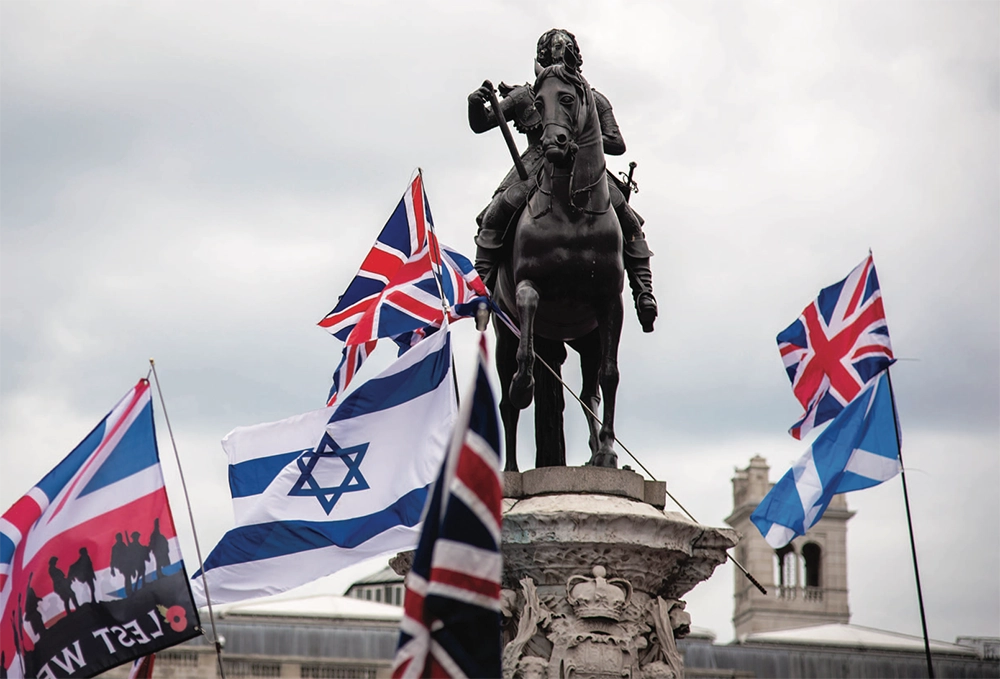
Protestors march with British and Israeli flags during the Unite the Kingdom March organised by Tommy Robinson to silence solidarity with Palestine and divide communities through racism and islamophobia. © IMAGO / Zuma Press Wire / Loredana Sangiuliano
What changed over the last decade is not primarily the existance of such sentiment, but its address. In the early 2000s, the framing of Muslims as an alien presence, incompatible with British life, incubating domestic terror, was largely the property of the tabloids. It is now carried by the comment pages of the Telegraph and the Spectator, the podcasts and prime-time shows of GB News, the Twitter feeds of sitting members of parliament. The rhetoric migrated from the red-top fringe to the broadsheet centre without any detectable change in content. Only the fonts improved.
Consider “British values”, a phrase that has functioned for nearly two decades as a polite device for designating Muslims the internal other. In its Prevent-era heyday it was a pedagogical instrument: schools were obliged to teach it, charities to profess it, mosques to demonstrate it. Nobody ever asked whether the Sikh temple or the synagogue or the parish church held British values. The question was reserved. When Keir Starmer’s Labour government came to power in July 2024, it inherited this architecture and, under the pressure of rioting and polling, chose not to dismantle it but to refine it.
A working group chaired by the former Conservative attorney general Dominic Grieve was established in February 2025 to define Islamophobia. Over a year later, in March 2026, the government settled on a preferred term: “anti-Muslim hostility”. Not Islamophobia. Hostility. The linguistic choice is small and telling. It avoids naming the thing.
This is what I have elsewhere called defensive secularism—a political grammar that treats Muslim difference as inherently dangerous to liberal order, and that licenses the state to manage Muslims not as citizens but as a problem to be contained. Defensive secularism is not the rhetoric of the street. It is the rhetoric of the chairman, the columnist, the review committee.