
Israel’s war on Gaza lasted 22 days and claimed the lives of over 1,200 Palestinians and 13 Israelis. The only way to make sense of this senseless war is through understanding the historical context. The State of Israel was established in May 1948 on the basis of a UN resolution.
Nevertheless, it involved a monumental injustice to the Palestinians. British officials bitterly resented American partisanship on behalf of the infant state. On 2 June 1948, Sir John Troutbeck wrote to the foreign secretary, Ernest Bevin, that the Americans were responsible for the creation of a gangster state headed by “an utterly unscrupulous set of leaders”. I used to think that this judgment was too harsh, but Israel’s vicious assault on the people of Gaza, and the Bush administration’s complicity in this assault, have reopened the question.
I write as someone who served loyally in the Israeli army in the mid-1960s and who has never questioned the legitimacy of the state of Israel within its pre-1967 borders. What I utterly reject is the Zionist colonial project beyond the Green Line. The Israeli occupation of the West Bank and the Gaza Strip in the aftermath of the June 1967 war had very little to do with security and everything to do with territorial expansionism. The aim was to establish Greater Israel through permanent political, economic and military control over the Palestinian territories. And the result has been one of the most prolonged and brutal military occupations of modern times.
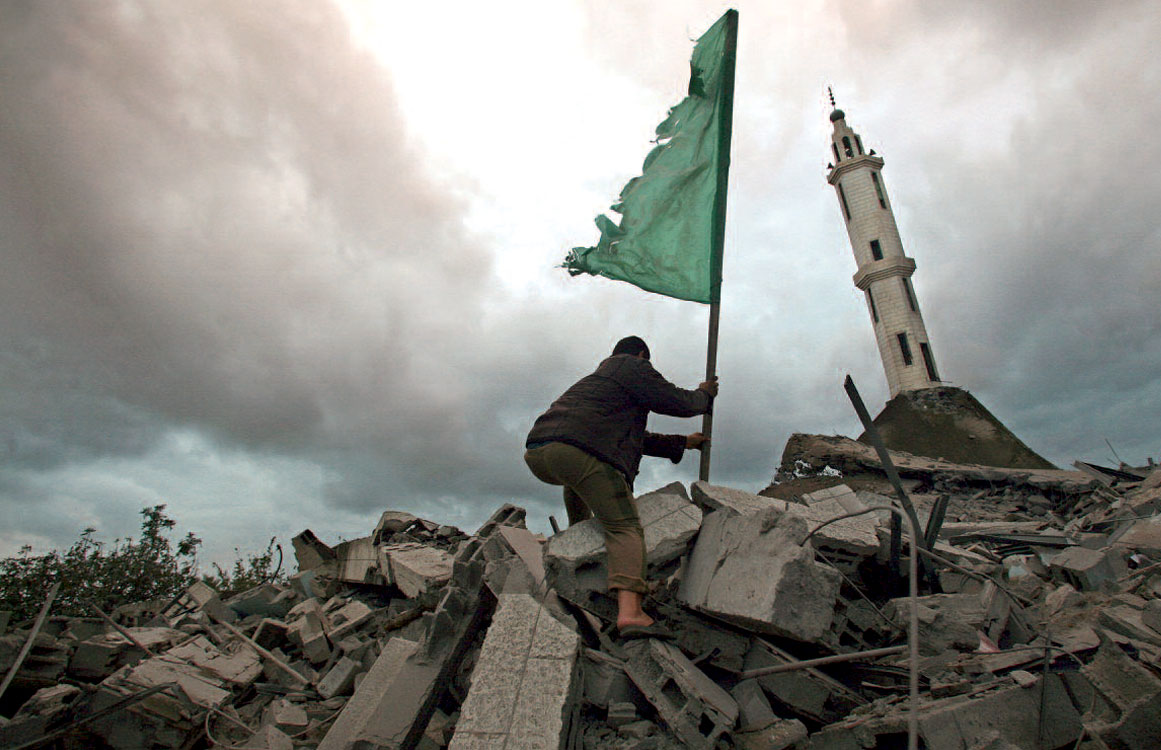
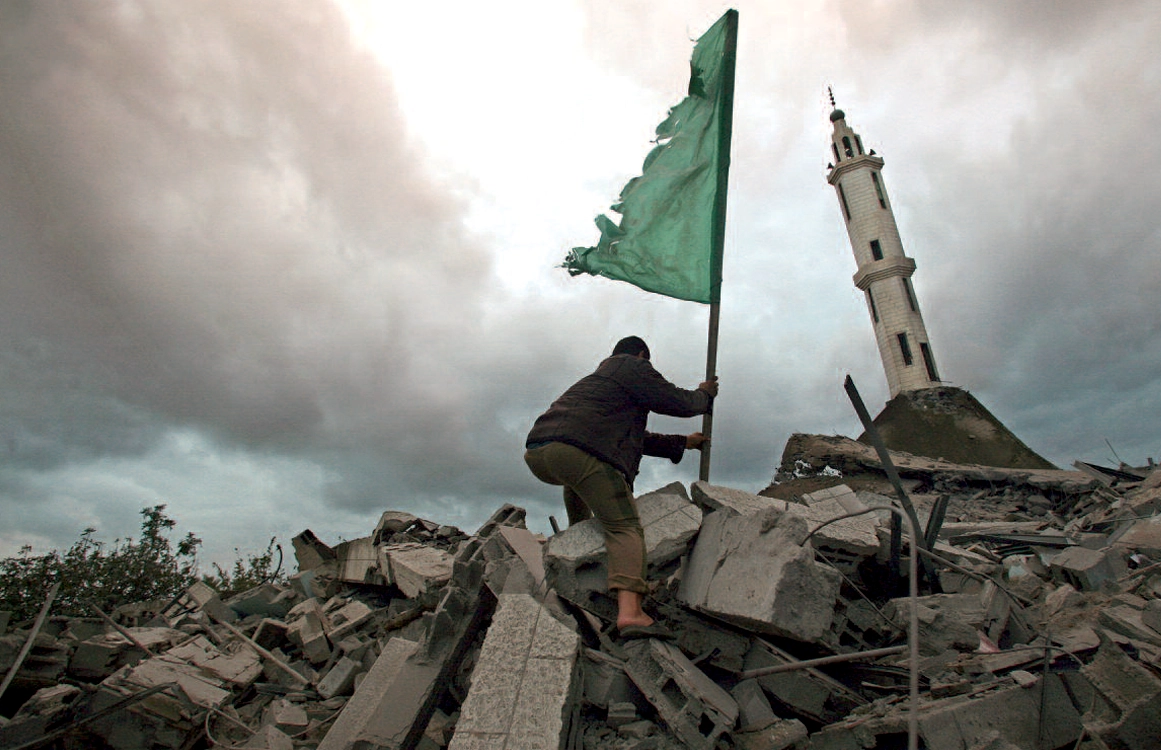
A Palestinian Hamas member puts a Hamas flag on the remains of the destroyed Abu Hanifa Mosque following Israeli airstrikes in the Tal al Hawa area, south of Gaza City
© MOHAMMED SABER/EPA/CORBIS
Four decades of Israeli control did incalculable damage to the economy of the Gaza Strip. With a large population of 1948 refugees crammed into a tiny strip of land, with no infrastructure or natural resources, Gaza’s prospects were never bright. Gaza, however, is not simply a case of economic under-development, but a uniquely cruel case of deliberate de-development. To use the biblical phrase, Israel turned the people of Gaza into the hewers of wood and the drawers of water, into a source of cheap labour and a captive market for Israeli goods. The development of local industry was actively impeded so as to make it impossible for the Palestinians to end their subordination to Israel and to establish the economic underpinnings essential for real political independence.
Gaza is a classic case of colonial exploitation in the post-colonial era. The building of civilian Jewish settlements on occupied Arab territories began in the immediate aftermath of the Six-Day War. These settlements are both illegal and an insurmountable obstacle to peace. They are at once the instrument of exploitation and the symbol of the hated occupation. In Gaza, the Jewish settlers numbered only 8,000 in 2005 compared with 1.4 million local residents. Yet the settlers controlled 25% of the territory, 40% of the arable land and a large share of the desperately scarce water resources. Cheek by jowl with these foreign intruders, the majority of the local population lived in abject poverty and unimaginable misery. Eighty per cent of them still subsist on less than $2 a day and rely for food rations on UNRWA, the UN Relief and Works Agency. The living conditions in the strip remain an affront to civilized values—a powerful precipitant to resistance and a fertile breeding ground for political extremism.
In August 2005, a Likud government headed by Ariel Sharon staged a unilateral Israeli pullout from Gaza, withdrawing all 8,000 settlers and destroying the houses they had left behind. Hamas, the Islamic resistance movement, conducted an effective campaign to drive the Israelis out of Gaza. The withdrawal was a victory for Hamas and a humiliation for the Israeli Defence Forces. To the world, Sharon presented the move as a contribution to peace based on a two-state solution. But in the year after the withdrawal, another 12,000 Israelis settled on the West Bank, further reducing the scope for an independent and territorially contiguous Palestinian state. Land-grabbing and peace-making are simply incompatible. Israel had a choice and it chose land over peace.
The real purpose behind the move was to redraw unilaterally the borders of Greater Israel by incorporating the main settlement blocs on the West Bank to the state of Israel. Withdrawal from Gaza was thus not a prelude to a peace deal with the Palestinian Authority, but a prelude to further Zionist expansion on the West Bank. It was a unilateral Israeli move undertaken in what was seen, mistakenly in my view, as an Israeli national interest. Anchored in a fundamental rejection of the Palestinian national identity, the withdrawal from Gaza was part of a long-term effort to deny the Palestinian people any independent political existence on their land.
Israel’s settlers were withdrawn but Israeli soldiers continued to control all access to the Gaza Strip by land, sea and air. Gaza was converted overnight into an open-air prison. From this point on, the Israeli air force enjoyed unrestricted freedom to drop bombs, to make sonic booms by flying low and breaking the sound barrier, and to terrorize the inhabitants of this prison.
Israel likes to portray itself as an island of democracy in a sea of authoritarianism. Yet Israel has never in its entire history done anything to promote democracy on the Arab side and has done a great deal to undermine it. Israel has a long history of secret collaboration with reactionary Arab regimes to suppress Palestinian nationalism. Despite all the handicaps, the Palestinian people succeeded in building the only genuine democracy in the Arab world with the possible exception of Lebanon and Morocco. In January 2006, free and fair elections for the Legislative Council of the Palestinian Authority brought to power a Hamas-led government. Israel, however, refused to recognize the democratically elected government, claiming that Hamas is purely and simply a terrorist organization.
America and the EU shamelessly joined Israel in ostracizing and demonizing the Hamas government and in trying to bring it down by withholding tax revenues and foreign aid. A surreal situation thus developed with a significant part of the international community imposing economic sanctions not against the occupier but against the occupied, not against the oppressor but against the oppressed.
As so often in the tragic history of Palestine, the victims were blamed for their own misfortunes. Israel’s propaganda machine persistently purveyed the notion that the Palestinians are terrorists, that they reject coexistence with the Jewish state, that their nationalism is little more than anti-Semitism, that Hamas is just a bunch of religious fanatics, and that Islam is incompatible with democracy. But the simple truth is that the Palestinian people are a normal people with normal aspirations. They are no better but they are no worse than any other national group. What they aspire to, above all, is a piece of land to call their own on which to live in freedom and dignity.
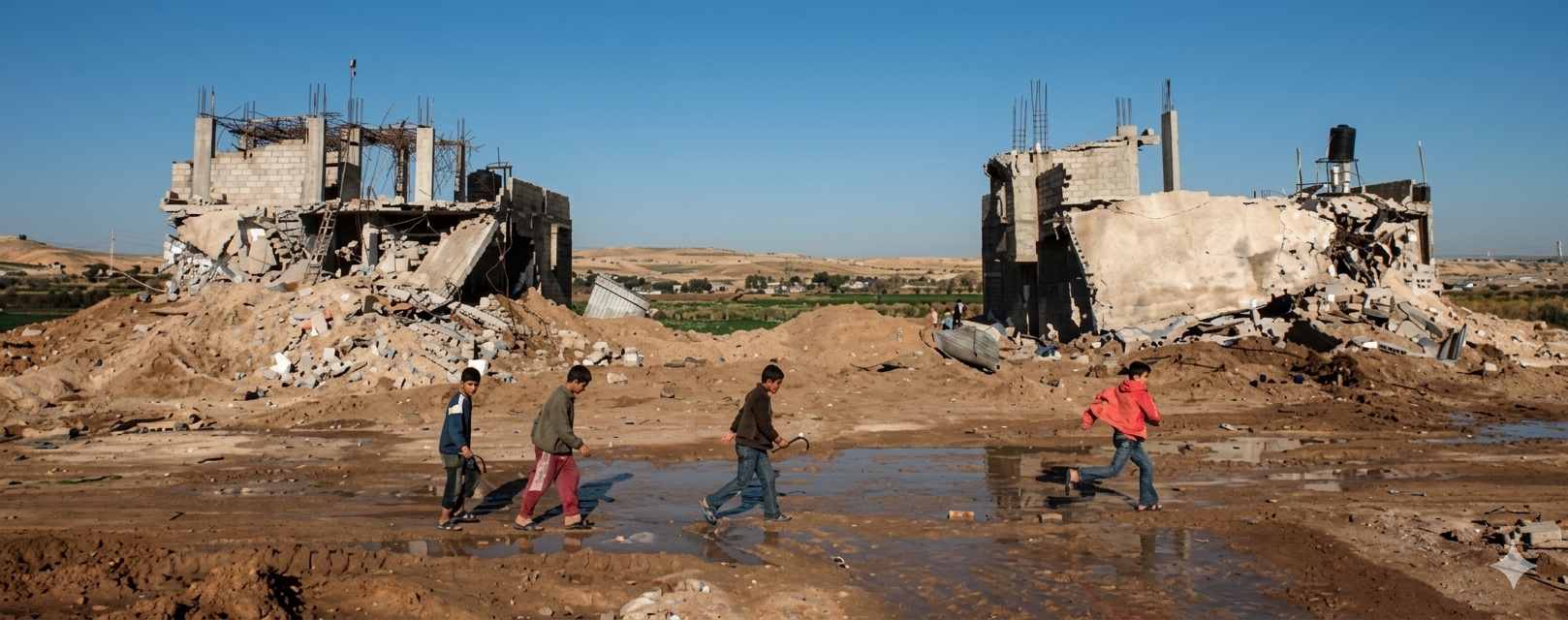
© AFP PHOTO / PATRICK BAZ
It is a little known but crucial fact that Hamas enforced the ceasefire very effectively on its side until Israel sabotaged it
Like other radical movements, Hamas began to moderate its political programme following its rise to power. It persisted in its refusal to recognize the Jewish state. But from the ideological rejectionism of its charter and its call for an Islamic state over the whole of mandatory Palestine, it began to move towards pragmatic accommodation to a two-state solution. Its spokesmen said many times that they would accept a Palestinian state within the 1967 borders and offered a long-term truce on that basis. In March 2007, Hamas and Fatah formed a national unity government that was ready to negotiate a long-term truce with Israel. Israel, however, refused to deal with a government that included Hamas. It rejected all negotiations with the political leadership of Hamas and preferred to try to smash its military wing instead.
At the same time Israel continued to play the old game of divide and rule between rival Palestinian factions. In the late 1980s, it had supported the nascent Hamas in order to weaken Fatah, the secular nationalist movement led by Yasser Arafat. Now it began to encourage the corrupt and pliant Fatah leaders to overthrow their religious political rivals and recapture power. Aggressive American neoconservatives participated in the sinister plot to instigate a Palestinian civil war. Their meddling was a major factor in the collapse of the national unity government and in driving Hamas to seize power in Gaza in June 2007 to pre-empt a Fatah coup.
The war unleashed by Israel on Gaza on 27 December was the culmination of a series of clashes and confrontations with the Hamas government. In a broader sense, however, it is a war between Israel and the Palestinian people, because the people had elected the party to power. The declared aim of the war was to weaken Hamas and to intensify the pressure until its leaders agreed to a new ceasefire on Israel’s terms. The undeclared aims were to drive Hamas out of power and to ensure that the Palestinians in Gaza are seen by the world simply as a humanitarian problem and thus to derail their struggle for independence and statehood.
The timing of the war was determined by political expediency. A general election is scheduled for 10 February and, in the lead-up to the election, all the main contenders are looking for an opportunity to prove their toughness. The army top brass had been champing at the bit to deliver a crushing blow to Hamas in order to remove the stain left on their reputation by the failure of the war against Hezbollah in Lebanon in July 2006. Israel’s cynical leaders could also count on apathy and impotence of the pro-Western Arab regimes and on blind support from President Bush in the twilight of his term in the White House. Bush readily obliged by putting all the blame for the crisis on Hamas, vetoing proposals at the UN Security Council for an immediate ceasefire, and issuing Israel with a free pass to mount a ground invasion of Gaza.