
As an experiment, I wrote out an outline for this article, which I rarely do, because I was fascinated with how ChatGPT might represent my words, tone, anger, and discernment if given the opportunity to craft my message. I gave ChatGPT a shot. My initial forecast was that the outcome would drift toward passive and “soft”. I even added information about Black Muslim existence and its importance in this conversation, and somehow it still made me sound complimentary—if not outdated. That’s where I begin this article.
Earlier this week, two devils attacked a mosque—a sacred place of worship—to impose trauma, death, and fear. We lost three Muslims because of the growing permissibility of Islamophobia in America. Calling someone “devils” shouldn’t be controversial if the name fits the act. The playbook surrounding this kind of diabolical violence will follow the same script it always does. The outrage will be loud. There will be janazahs. There will be fundraising campaigns, vigils, statements, hashtags, and temporary solidarity. Then silence… until the next act of hatred arrives. We are a country of episodic rage, and therefore episodic justice.
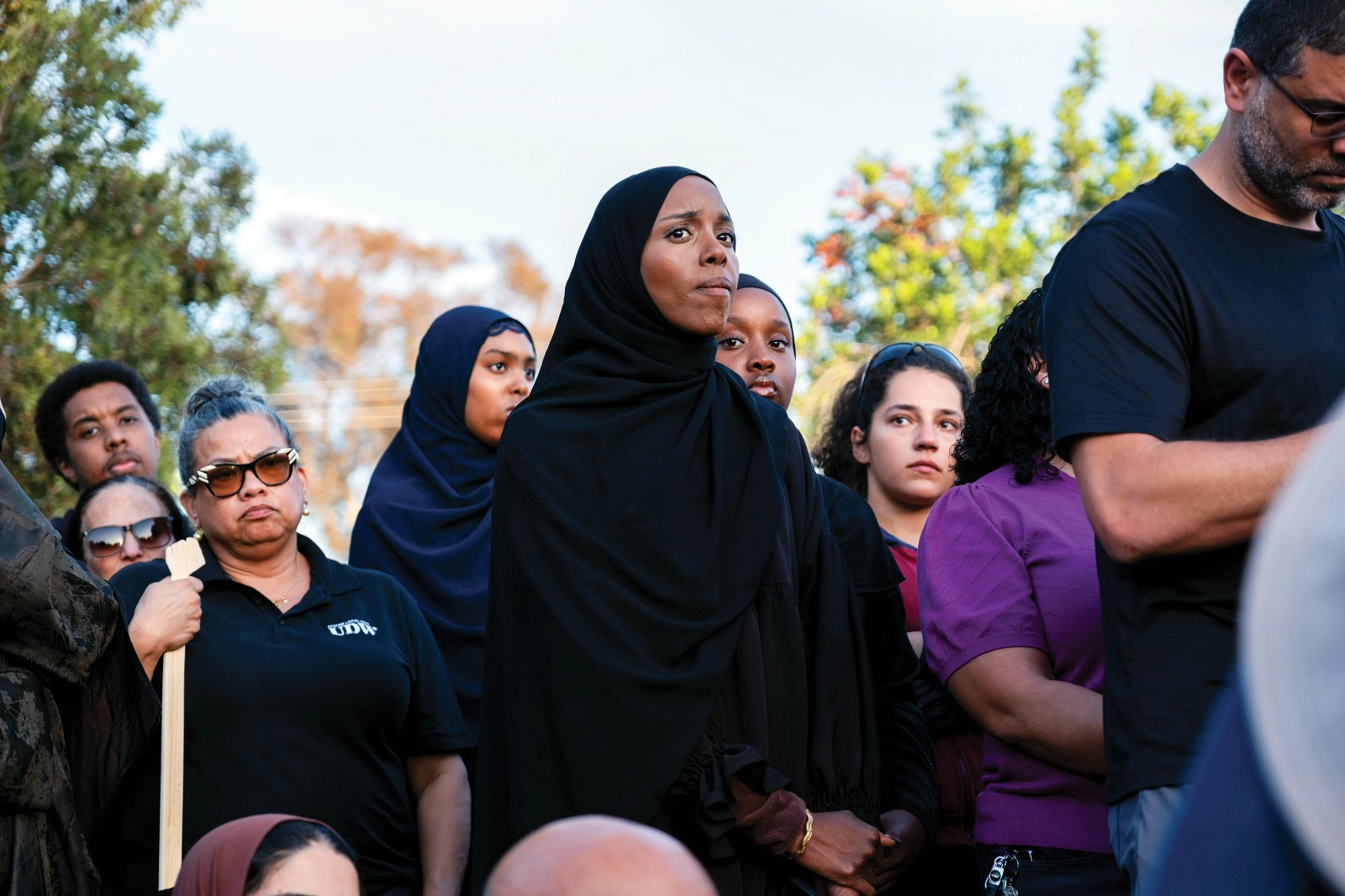
San Diego interfaith community vigil at Lindbergh Park in San Diego, California on 19th May, 2026 to honor the three men killed in a tragic shooting at the nearby Islamic Center.
© IMAGO/Lauren Puente
I pause here to emphasize that I’m not a cynic. Worse. I’m a child of the ’60s. I know the tricks associated with muddying the waters between faith and psychological surrender. That is precisely where we find ourselves today.
So let me ask a question:
When does patience become passivity?
A simple answer might be: when there is an agenda that benefits from your silence.
This is not merely a Muslim issue. This is a human issue. The idea of discernment has become nearly criminal because we’ve grown accustomed to people making decisions for us—morally, politically, spiritually, emotionally. But what happens when you no longer trust those people to protect your welfare because they’ve repeatedly demonstrated that your safety is negotiable? Exactly how long are you supposed to wait for the “powers that be” to finally “get it right”?
The term I want to reintroduce into this discussion is passive morality—the tendency to avoid justice-oriented emotions in order to appear peaceful, neutral, or socially acceptable. Many Muslims are now afraid to engage honestly with the raw emotional trauma that comes with being Muslim in an openly Islamophobic America. But neutrality in the face of oppression is not the standard operating procedure of Islam, nor was it the example of our Beloved Prophet Muhammad ﷺ. Islam teaches restraint, wisdom, patience, and mercy. That part is clear. But Islam does not teach surrender to humiliation, abuse, or degradation. “Turning the other cheek” was never meant to become an invitation for society to endlessly threaten, mock, or attack Muslims.
The modern Muslim is now living a Black reality inside a digital economy.
You think I’m “bringing race into this tragedy”? My response is: what if I am? What exactly are you going to do about it?
That sounds aggressive, doesn’t it?
Well, that’s what an honest conversation sounds like once passive morality exits the room.
It wasn’t long ago, during the pandemic, that I argued America had reached the apex of its moral and spiritual sickness. The illness began when people decided history itself was negotiable. Those who feel entitled to rewrite history will always find others depraved enough to help them do it. More importantly, they understand something deeply unsettling: they assume the first response of the intended victim will be patience and mercy.
That strategy only works if passive morality becomes the dominant ethic within oppressed communities.
And that is the dangerous part.
In light of the recent attack and tragic loss of life, I honestly wonder what the outcome might have been had society drawn a clearer line years ago—if Islamophobia had been socially understood as something that carries real consequences. Call it a halal version of “Stand Your Ground”.
Now some people will hear that and immediately think, “Preacher Moss sounds like a halal bully.”
Maybe.
But as a Black Muslim, I live at the intersection of three pressures:
- Institutional white supremacy
- Legally enforced American exceptionalism
- The poison of self-hatred
The uncomfortable truth is that many non-Black Muslims are now arriving at the same intersection.
Institutional white supremacy means recognizing that many Muslims remain excluded from meaningful political power despite all the speeches about diversity and inclusion. There is no parity when it comes to racism, Islamophobia, or poverty. The criminalization of Muslim identity in America did not begin after 9/11. It began with the first enslaved Muslims brought to these shores centuries ago. The fear of Islam has always been tied to the fear of independent moral consciousness—the fear that somebody might expose hypocrisy while still claiming faith.
For Black Muslims, white supremacy has always been two-fold: anti-Blackness and Islamophobia operating simultaneously. The dehumanization of Black Muslims has been visible since the 1600s. Black Muslim survival itself became threatening because spiritual mobility produces anxiety in systems built on hierarchy.
The message from Black Muslims has long been simple:
Passive morality kills.
Wake up.
I say that from a place of concern, not hatred. Oppressors rarely admit oppression exists. Likewise, those who practice immorality almost never describe themselves as immoral.
Then comes legally enforced American exceptionalism—the idea that America remains morally superior regardless of contradiction. For Muslims, that becomes spiritually dangerous because it subtly asks people to worship national mythology over truth itself. When patriotism becomes untouchable, accountability disappears. And once accountability disappears, injustice becomes policy.
Many Black Muslims, immigrant Muslims, and marginalized people reject American exceptionalism because they understand its exclusions. More than that, they understand that systems rooted in supremacy cannot tolerate comparison, historical honesty, or genuine competition. The moment you question that mythology, you are labeled “anti-American”, divisive, radical, or dangerous.
Did I say elections?
The final pressure is the poison of self-hatred. This may be the most dangerous one because it operates internally. Once people are conditioned to doubt their own worth, silence their own instincts, and distrust their own discernment, they become easier to pacify. Social media accelerates this sickness daily. We are constantly fed images of violence, humiliation, fear, and chaos. One minute it’s a bombing. The next minute it’s a meme. Then an ad for sneakers. Human suffering has become content.
That changes people psychologically.
It radicalizes some.
It emotionally paralyzes others.
And many people are left trapped somewhere in between—exhausted, numb, and spiritually disoriented.
So where do we go from here?
We reclaim discernment.
Discernment means understanding when mercy heals and when silence harms. It means recognizing that Muslims are not obligated to absorb endless humiliation simply to appear peaceful. True peace requires justice, safety, courage, and moral clarity. It also means confronting the psychological warfare produced by modern media ecosystems that normalize fear while draining communities emotionally and spiritually.
Most importantly, it means refusing to confuse patience with surrender.
As we close, I ask Allah to shower His mercy upon those who lost their lives in this tragedy. May He grant them the highest levels of Jannah, forgive their sins, widen their graves with light, and place tranquility upon their souls. May Allah grant strength, patience, and healing to their families, their loved ones, and the entire community struggling under the weight of grief and fear.
And may Allah protect all vulnerable communities from hatred disguised as patriotism, from propaganda disguised as truth, and from passive morality disguised as righteousness.
Ameen.